Jim Boards the Hispaniola
Jim Hawkins's boarding of the Hispaniola is the turning point of his sea adventure and, in effect, of the entire treasure hunt. After overhearing the mutineers' plot in the apple barrel and witnessing the murder of Tom, Jim had fled into the island's interior, where he met the marooned Ben Gunn. Now, having found Ben Gunn's homemade coracle hidden under the white rock, Jim conceives a daring plan: to slip out under cover of night, cut the Hispaniola adrift, and let her go ashore where she fancied. This act of truantry, as he himself calls it, is his second folly—far worse than the first, for he leaves but two sound men to guard the stockade—yet it proves a help towards saving all of them.
The Coracle and the Approach
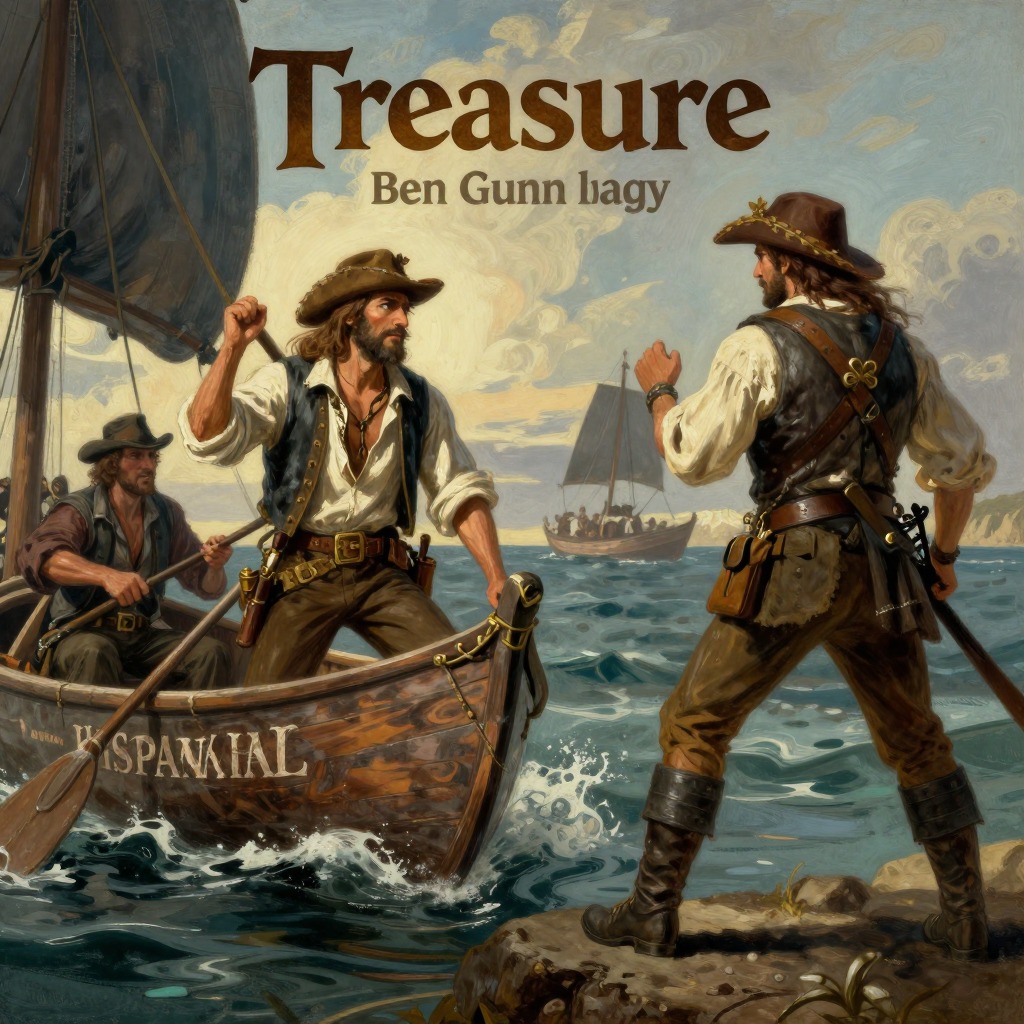
Jim's vessel is Ben Gunn's boat, a rude, lop-sided framework of tough wood covered with goatskin, with the hair inside. It is extremely small, even for a boy, and Jim later compares it to the first and worst coracle ever made by man. It is exceedingly light and portable, but cross-grained and lop-sided to manage, always making more leeway than anything else and turning round and round as its best manoeuvre. Jim does not know her way, and he is very sure he never should have made the ship at all but for the tide. By good fortune, paddle as he pleases, the ebb tide sweeps him down, and there lies the Hispaniola right in the fairway, hardly to be missed. As he approaches, the schooner looms before him like a blot of something yet blacker than darkness, then her spars and hull begin to take shape. He comes alongside her hawser and lays hold. The hawser is as taut as a bowstring, and the current so strong that she pulls upon her anchor. Jim recalls that a taut hawser, suddenly cut, is as dangerous as a kicking horse, and he hesitates. But a puff of wind catches the schooner, forces her up into the current, and the hawser slackens in his grasp. He takes out his gully, opens it with his teeth, and cuts one strand after another, till the vessel swings only by two. Then he waits, and when the breeze comes again, he cuts the last fibres through. The schooner begins to turn upon her heel, spinning slowly, end for end, across the current, and Jim is almost instantly swept against her bows. He works like a fiend to push the coracle astern, and as he gives the last impulsion, his hands come across a light cord trailing overboard across the stern bulwarks. Instinctively he grasps it, and curiosity gets the upper hand: he determines to have one look through the cabin window.
Boarding and the State of the Ship
Jim pulls in hand over hand on the cord, and when he judges himself near enough, rises at infinite risk to about half his height and commands the roof and a slice of the interior of the cabin. One glance is sufficient: he sees Israel Hands and his companion locked together in a deadly wrestle, each with a hand upon the other's throat. He drops back onto the thwart, none too soon, for he is near overboard. The schooner, unsteered, sails by swoops and dashes, to and fro, up and down, north, south, east, and west, ending each repetition with idly flapping canvas. Jim concludes that nobody is steering, and that the men are either dead drunk or have deserted her. He decides that if he can get on board, he might return the vessel to her captain. He paddles after the unsteered Hispaniola, and after a long and perilous chase, the schooner comes stooping over the next swell, her bowsprit over his head. He springs to his feet and leaps, stamping the coracle under water. With one hand he catches the jib-boom, while his foot lodges between the stay and the brace. A dull blow tells him that the schooner has charged down upon and struck the coracle, and that he is left without retreat on the Hispaniola.
Striking the Jolly Roger
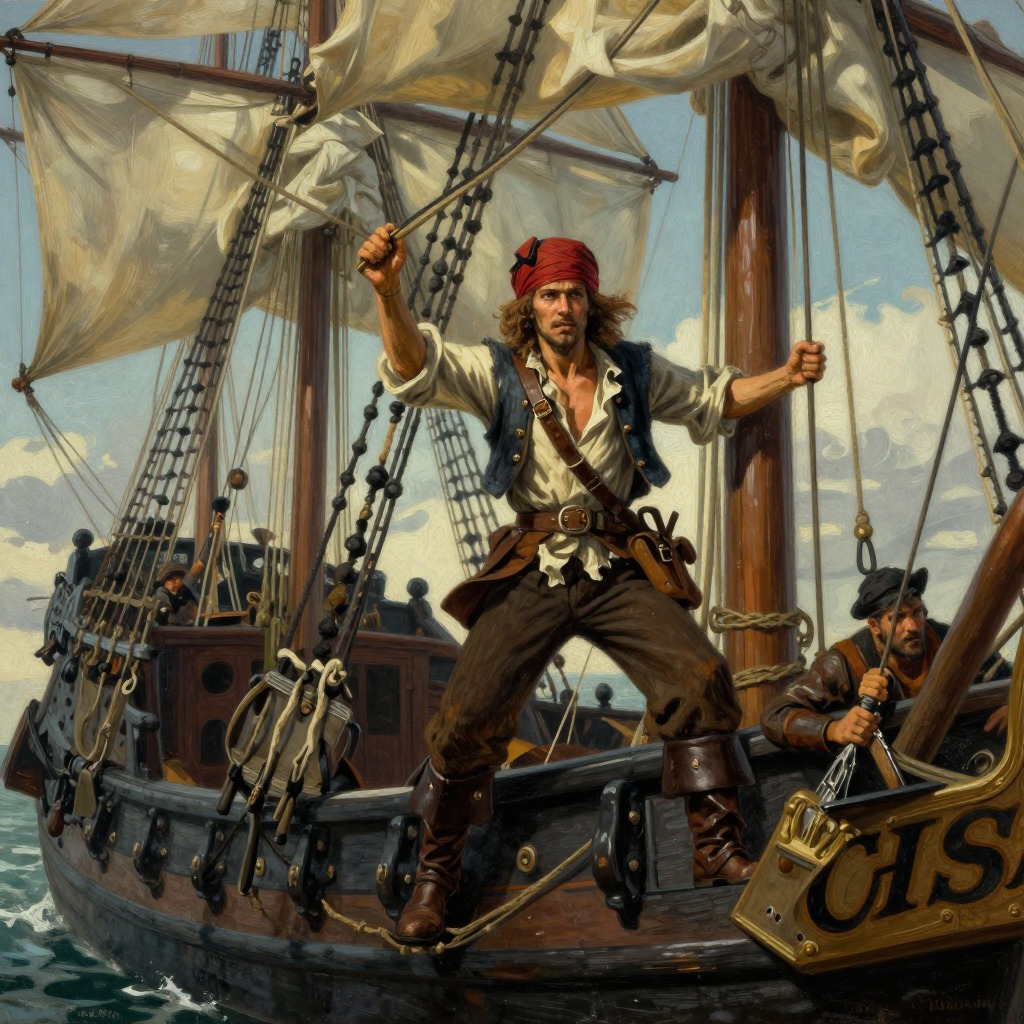
Once aboard, Jim finds the deck deserted. The planks, not swabbed since the mutiny, bear the print of many feet, and an empty bottle, broken by the neck, tumbles to and fro like a live thing in the scuppers. As the ship comes into the wind, the main-boom swings inboard and shows him the lee after-deck. There lie the two watchmen: red-cap on his back, as stiff as a handspike, with his arms stretched out like those of a crucifix and his teeth showing through his open lips; Israel Hands propped against the bulwarks, his chin on his chest, his hands lying open before him on the deck, his face as white, under its tan, as a tallow candle. Splashes of dark blood surround both, and Jim feels sure they have killed each other in their drunken wrath. He walks aft to the main-mast and addresses Hands ironically: "Come aboard, Mr. Hands." Hands rolls his eyes round heavily, too far gone to express surprise, and utters only one word: "Brandy." Jim goes below into the cabin, a scene of confusion—lockfast places broken open in quest of the chart, the floor thick with mud, bulkheads bearing a pattern of dirty hands, dozens of empty bottles clinking in corners, and the doctor's medical book lying open on the table, half its leaves gutted out for pipelights. He finds a bottle with some brandy left for Hands, and for himself some biscuit, pickled fruits, a great bunch of raisins, and a piece of cheese. He comes on deck, puts his own stock behind the rudder head, goes forward to the water-breaker for a deep drink, and then gives Hands the brandy. Hands drinks a gill before taking the bottle from his mouth. Jim tells him, "I've come aboard to take possession of this ship, Mr. Hands; and you'll please regard me as your captain until further notice." Then, dodging the boom, he runs to the colour lines, hands down the cursed black flag, and chucks it overboard. "God save the king!" he cries, waving his cap. "And there's an end to Captain Silver!"
The Bargain with Hands
Hands, though wounded, proposes a bargain: if Jim gives him food and drink and a scarf to tie his wound, he will tell him how to sail the ship. Jim declares he means to get into North Inlet and beach her quietly there. Hands, seeing he has no choice, agrees, and in three minutes they have the Hispaniola sailing easily before the wind along the coast of Treasure Island. Jim lashes the tiller and goes below to his chest, where he gets a soft silk handkerchief of his mother's. With this, and with Jim's aid, Hands binds up the great bleeding stab he has received in the thigh. After eating a little and swallowing more brandy, Hands begins to pick up visibly, sitting straighter, speaking louder and clearer. Jim is greatly elated with his new command, pleased with the bright, sunshiny weather and the different prospects of the coast. His conscience, which had smitten him hard for his desertion, is quieted by the great conquest he has made. Yet he cannot help noticing the coxswain's eyes following him derisively about the deck, and the odd smile that appears continually on his face—a smile with something of pain and weakness, but also a grain of derision, a shadow of treachery, as he craftily watches Jim at his work.
Significance and Aftermath
Jim's boarding of the Hispaniola is the decisive act that recaptures the ship for the loyal party. It is the culmination of his sea adventure, which began with his folly of going ashore and his discovery of Ben Gunn. By striking the Jolly Roger and taking possession of the schooner, Jim not only deprives the mutineers of their means of escape but also provides the loyal party with the vessel they need to leave the island. The act is a direct consequence of Jim's earlier overhearing of Silver's plot in the apple barrel, and it sets the stage for the final confrontation at the treasure pit, where the doctor, Gray, and Ben Gunn ambush the mutineers. Jim's courage and resourcefulness in boarding the ship, despite his youth and the dangers, mark him as the true hero of the adventure, and his actions are later acknowledged by the captain and the squire. The recapture of the Hispaniola is a clenching answer to his truantry, and it ensures that the treasure, though found by Ben Gunn, can be transported home. Jim's boarding thus stands as the pivotal moment when the fortunes of the honest men turn decisively in their favor.